
Designing a programme
Don’t forget it is not up to the group leader to decide what the group listens to and remember the u3a ethos of shared, participative, and self-help learning. However, if members have run out of ideas it is always useful to have a few subjects to hand (my thanks to Ray Wilson of St Albans Jazz Appreciation Group for some of these):
- Desert island discs
- Google top jazz albums
- The Great American Song Book composers.
- Stage musicals and films
- Jazz music to dance to
- Jazz Giants
- Jazz Techniques (melody, rhythm, harmony, improvisation)
- Instruments (saxophone, trumpet, trombone, flute, guitar, violin, piano, etc.)
- Jazz styles (Blues and roots, Ragtime and stride, New Orleans, Chicago and New York, Pre-war singers, Swing, Bebop, Cool jazz, Hard bop, Early funk, Mainstream, Post-war singers, Free jazz, Postbop big bands, Latin jazz, Fusion, Worldbeat, Gypsy jazz, Nu Jazz, Modal jazz, etc. etc.)
- Jazz decades
- Jazz album covers
- Different versions of the same song or tune.
- Early British jazz
- The Dankworth Dynasty
- Jazz award winners
- Live Jazz – listening to live jazz and feeling the rapport between musicians and audience at your local pub, jazz club, or festival can feel more rewarding than listening to recorded music.
- The Sandy Brown Jazz website includes quizzes, features, and articles for discussion.
Local Jazz History
The members of your u3a group will have a unique pool of knowledge and memories of the life and culture of the local area. Why not compile a collection of jazz related items and anecdotes. Documents, photographs, posters, programmes and recordings can all be useful and of interest. If you would like help with such a project, please get in touch with me and/or liaise with the National Jazz Archive.
Ideas for programmes shared with other u3a groups
Why not spice up your u3a by having joint meetings with other groups in your area?
- Jazz and Art – A recent book by Alyn Shipton called The Art of Jazz highlights the art and design associated with the music, dance, and, of course, The Jazz Age.
- Jazz and Spirituality – John Coltrane and Duke Ellington are just two examples of intensely spiritual musicians who composed sacred music. Consider also the influence of spiritual songs and gospel music.
- Jazz and Computers – Miles Davis was one of the first musicians to incorporate electronic effects into his performance, as evident in the album In A Silent Way (1969). Compare with other electronic music pioneers such as Kraftwerk.
- Jazz, History, and Politics –Jazz developed from music that travelled from Africa with enslaved peoples. Continuing racial discrimination in America and elsewhere inspired protest songs (e.g. Strange Fruit sung by Billie Holiday) designed to highlight injustice.
- Jazz and Photography – Photographing live musicians is a great skill, and the best pictures capture the unique character of the artist.
- Jazz performance – many u3a groups have formed bands of various types. Playing jazz is very enjoyable and provides extra insight into how the music works.
- Jazz and Dance – Jazz music has a unique ability to inspire movement and dance.
- Jazz and Singing – The jazz canon includes many great songs, gospel, and even choral works.
- Live Jazz - Invite local musicians to perform and talk about their music at your monthly general meeting. Visit local jazz clubs.
Jazz Blogs
Many jazz enthusiasts regularly write about Jazz in online blogs or magazines, many of which are free to read. Click on the button below for links to jazz blogs. Online blogs include Bebop Spoken Here, Jazz Wax, The Blue Moment, and The Jazz Mann.
Books, Magazines, Websites, Collections and Other Resources
There are many books and encyclopaedias about Jazz. These include The All-Music Guide to Jazz, The Rough Guide to Jazz and The Penguin Guide to Jazz. Searching on the word jazz on the Waterstones Bookshop website will produce over 5000 items.
There are also several magazines available online but only a few such a Jazzwise and The Jazz Rag are available in hard copy. Online only magazines include Jazz Journal, UK Jazz News, What’s New .
The British jazz scene also has a lively “Trad Jazz” element which is catered for by The Jazz Guide and Traditional Jazz.
The organisation Cecilia is an on-line guide to music collections in archives, libraries and museums in the UK and Ireland.
The Jazz Centre UK has a wealth of resources it would love you to use. It also collects memorabilia and will accept items such as record collections.
The Duke Ellington Society has information about the great composer and bandleader.
The Jazz Standards website provides a lot of free information about many aspects of Jazz.
Performing music
There are a few u3a groups who have formed jazz or swing bands, either to amuse themselves or to play live gigs. Often the bands include players from more than one u3a district. Here are some that I know about:
St Albans - Jazz in the Third Age swing band
Balsall Common - Swing Division
Elmbridge - Eu3a Jazz Band
South Bucks - Jazz Band
Woking - Second Wind
Worksop - Simply Swing
Please be aware when sourcing sheet music that copyright regulations apply.
Organising Live Gigs
A few U3a groups also organise live gigs. A local u3a band might play for little money but hiring a professional band is going to involve a substantial sum. The Musician’s Union publishes performance fees for professional musicians. Not everyone charges these rates, but it is as well to be aware of them. Organising commercial events brings with it certain responsibilities. Copious advice, including advice about insurance may be found in themembers area of the u3a website.
U3a groups who successfully organise live gigs or visit local jazz clubs as a group include
Guildford
Epsom and Ewell
Windsor
Crouch Valley
Connecting musicians
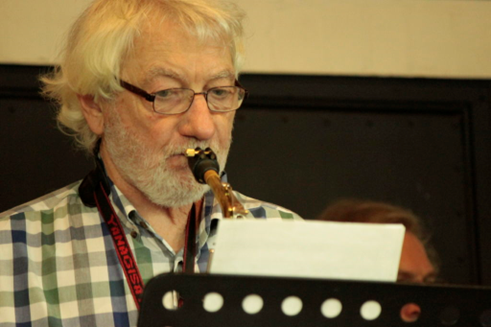
This is me playing alto saxophone in my local, amateur band. Please let me know if you play an instrument and would like me to put you in touch with other u3a members in your area who would like to play music together in a group.
Services provided by u3a members to u3a groups
John Dando gives presentations on New Orleans jazz from its beginnings in the 1920s and its later revival featuring the music of Jelly Roll Morton, Louis Armstrong and King Oliver. No fee, of course, but he would ask for petrol costs to be met. He is based in Somerset and will also travel to Wiltshire and Dorset.
Contact John Dando.Hugh Parry has a large collection of old recorded material on shellac 78s and phonograph cylinders, together with a variety of machines capable of reproducing several formats. He gives illustrative talks to the u3a groups and can present a programme of music on wind-up gramophones (nothing post-1960, for obvious reasons), which is how that music would have been heard in its own day. No fee, of course, but he would ask for petrol costs to be met. He is based in Aberystwyth.
Contact Hugh Parry.Chris Clark plays keyboard with two amateur bands based around Bristol that play in local venues such as pubs, village halls, garden centres and summer fairs etc. The repertoire is mainly 50s and 60s jazz standards by artists such as Horace Silver, Joe Henderson, Dizzy Gillespie, Herbie Hancock, Dave Brubeck, Miles Davis, Michael Brecker, Benny Golson and Hank Mobley as well as American song book standards. The quintet has played at u3a meetings several times without charge but help with travelling expenses would be nice but not obligatory.
Contact Chris Clark.The History of Epsom and Ewell u3a Jazz Group
I am very grateful to Michael Stevens for providing this text and information.
First Draft 13/7/24 - History of the Epsom & Ewell u3a Jazz Group – “Epsom Hot Jazz Club”
I started our u3a Jazz Group in September 2011 at All Saints Community Hall, West Ewell, KT19 9QY where we continue to hold our monthly meetings on the second Tuesday afternoon every month. Hall Manager, Peter Turner, was interested in traditional jazz, becoming one of our first regular members. A good kitchen enables our half time break. Socialising with tea and cakes has always been a key feature of our meetings.
Initially I gave talks on the history of jazz using my projector and screen to show readily available early jazz film clips from YouTube plus jazz movies. Back then the copyright authorities were actively monitoring music and threatening pubs, jazz clubs and other venues for using live or recorded music. Our National u3a licences for music and film avoided this problem which had led to so many problems for other live music organisers.
I was fortunate in having John White, a retired BBC sound engineer, who wheeled in his equipment every month to provide us with first class sound. I always first recorded my illustrated talks on to DVD which I found reliable and gave a good sound feed for John. A quick setup and avoidance of breakdowns were vital. I uploaded most of these early meetings to YouTube under my YouTube name “JazzVideoMike”. Click on the following to find a few of the most popular viewings:
1920s Hot Hot Dance - (2.4 million views)
Cakewalk to Jazz 1877-1917 - (63,000 views)
British traditional jazz 1953 to 1963 - (375.000 views)
British Traditional Jazz (Part 2) - (72,000 views)
The New Orleans Style of Jazz Part 1 - 1914 to 1935 - (375,000 views)
Fire House Five+2 - (60,000 views)
I projected jazz movies made from the late 1920s through to the present day and I also engaged prominent speakers such as the late Micheal Pointon to speak to us. Quite early on I started to have a live jazz band for our December meetings. Hugh Crozier arranged bands for our first two Christmas Parties, and then I engaged Keith Nichols to bring his Hot Five through to 2019 and the pandemic, from which Keith was unfortunately an early victim.
The u3a has helped greatly in providing members, especially for the Christmas Party where I often had a capacity audience of almost 100, but meeting numbers were usually around 25 - not enough to pay for live bands, but our members wanted live bands, so I needed higher attendance. I started advertising using the name “Epsom Hot Jazz Club” in the jazz press and booking the best traditional jazz bands available. Regular attendance has now risen to 50 to 60+, with u3a members having lower entrance fees.
Since the pandemic the cost of hall rental and bands has increased substantially, so entry tickets are currently priced at £15 for u3a members and £17 for non-members. Members from other u3as are welcomed at the member price. These prices are comparable to other jazz clubs in the Southeast.
I would be happy to help anyone wishing to set up a u3a traditional jazz group by lending out equipment and permitting use of my video DVDs.
Mike Stevens
Epsom & Ewell u3a Jazz Group