
This Future Flight page explores the next era of aviation, driven by rapidly advancing technology. As innovation soars, the phrase "the sky is the limit" takes on new meaning. Content is drawn mainly from verified, open-source online publications to ensure accuracy.
5 June 2025
Boom Supersonic
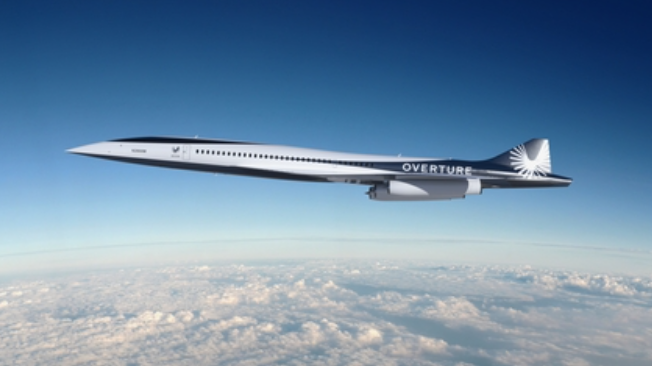
Boom Supersonic is advancing the development of its Overture airliner, aiming to reintroduce commercial supersonic travel by 2029. The Overture is designed to cruise at Mach 1.7, accommodating 64 to 80 passengers, and covering routes such as London to New York in approximately 3.5 hours
A significant milestone was achieved in early 2025 when Boom's XB-1 demonstrator successfully broke the sound barrier, validating key technologies for the Overture . The company is also developing the Symphony engine, a medium-bypass turbofan intended to power the Overture. Development partners include Florida Turbine Technologies for engine design, GE Aerospace subsidiary Colibrium Additive for additive manufacturing consulting, and StandardAero for maintenance. Boom aims to begin engine production in 2025 at its Greensboro, North Carolina facility.
Boom has secured 130 orders and pre-orders from airlines such as American Airlines, United Airlines, and Japan Airlines, reflecting strong commercial interest . The company plans to commence assembly in 2025, with the first aircraft rollout in 2026, test flights in 2027, and FAA certification by 2029 .
Emphasizing sustainability, the Overture is designed to operate on 100% sustainable aviation fuel, aiming for net-zero carbon emissions from its first day of service .
Additionally, Boom is exploring a "Boomless Cruise" capability, allowing the aircraft to fly at supersonic speeds without producing disruptive sonic booms over land.
With these developments, Boom Supersonic is on track to revolutionize air travel by offering faster, more sustainable, and commercially viable supersonic flights by the end of the decade.
Boom Overture supersonic aircraft (redesigned 2022) rendering
Copyright © 2022 Boom Supersonic.
Breaking the Sound Barrier - Again
A new bill in the US Congress could lift the outdated ban on supersonic flight over land, unlocking the future of fast and quiet travel.
For over 50 years, the United States has imposed a speed limit in the skies, a federal ban that prohibits civilian aircraft from exceeding the speed of sound over land. The primary concern? Sonic booms, which are loud shockwaves generated when planes break the sound barrier.
However, many people are unaware that modern aircraft can travel faster than the speed of sound without producing a disruptive boom on the ground. Regulations need to evolve to keep pace with these developments and key lawmakers in Washington, D.C., are currently taking action to address this issue.
The supersonic ban has stifled innovation in the American aviation industry and its knock-on effects are far-reaching. The U.S. has always been the global leader in aerospace innovation, just not when it comes to commercial aircraft speed. Countries like China are investing in advanced high-speed aircraft, and it’s time for the U.S. to do the same or be left behind.
Flying faster, quietly, with Boomless Cruise
Since the ban was first imposed in 1973, the aviation industry has undergone a revolution. Advances in aerodynamics, propulsion, and materials science provide the technology to make flights faster and quieter as well as more fuel-efficient, safer, and more sustainable. Supersonic travel today is no longer synonymous with noise; instead, supersonic embodies breakthrough efficiency, precision engineering, and remarkably reduced travel times.
Earlier this year, Boom’s demonstrator aircraft XB-1 successfully broke the sound barrier six times without generating an audible boom on the ground. This achievement is attributed to a well-established principle in physics known as Mach cutoff, which causes a sonic boom’s shockwaves to dissipate their energy before reaching the surface. As a result, the U.S. now has the lead in the supersonic race with the only flying civil supersonic aircraft.
We refer to this innovative concept as Boomless Cruise, a mode that allows for supersonic flight without the disruptive sonic boom. It’s not just theoretical, it’s a tangible reality, which will enable Overture to fly at supersonic speeds over land.
Up to Mach 1.3 over land
Once the ban is lifted, Overture’s Boomless Cruise mode will allow speeds up to Mach 1.3 over land. This is up to 50% faster than today’s jets, with no audible boom for communities below. Travelers could save up to 90 minutes on U.S. coast-to-coast routes, and global routes with overland segments would see even more significant benefits. With Boomless Cruise, a flight from LA to D.C. is 3 hours and 15 minutes instead of 4 hours and 35 minutes, and a flight from Miami to Seattle is only 3 hours and 40 minutes compared to 5 hours and 15 minutes.
We’re closer to supersonic flight than you think. Once the ban is lifted, we can unleash the full power of American innovation and make flying at supersonic speed the norm, not the exception. Thanks to the leadership of key aviation policy lawmakers, we are one step closer to making this happen.
18 Jun 2025
Airborne Uber
Urban air mobility (UAM) is rapidly reshaping the future of aviation and Wisk Aero, a wholly owned subsidiary of Boeing, is at the forefront of this transformation. The company plans to market their electric vertical takeoff and landing (eVTOL) air taxis in Miami and Japan.
At the heart of Wisk’s innovation is its autonomous Gen 6 air taxi, a four-passenger aircraft designed to operate without an onboard pilot. Instead, it is monitored by ground-based personnel who can intervene if necessary. With a range of 72 nautical miles and cruising speeds between 110 and 120 knots, the Gen 6 is optimized for short, regional hops, which are ideal for congested urban corridors. Wisk aims to launch commercial passenger flights by the end of the decade, with pricing comparable to Uber’s surge fares, offering a practical and accessible alternative to ground transportation.
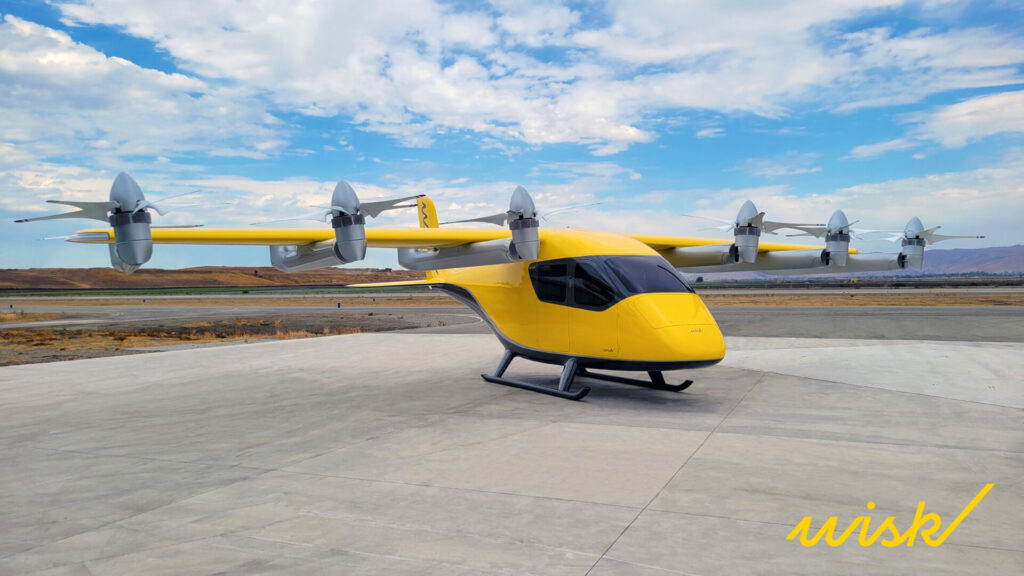
Image: Copyright Wisk Aero
Miami and Japan represent two forward-looking regions preparing to integrate autonomous air taxis into their urban infrastructure. The Miami-Dade Aviation Department (MDAD) is proactively planning to incorporate UAM into its airport and airspace management systems. Key airports include Miami International (KMIA), Opa-locka Executive (KOPF) and Miami Executive (KTMB), which are being evaluated as potential vertiport sites. Wisk will contribute technical expertise to help design electrified infrastructure and develop flight procedures, ensuring seamless integration with existing aviation operations.
Innovation in UAM doesn’t stop with infrastructure. Academic and regulatory collaboration is essential and Wisk is forging those connections. The University of Miami will play a research role, examining autonomous technology, safety protocols, regulatory frameworks, and potential business models. This partnership will provide Wisk with valuable academic insight, research capabilities, and access to grant opportunities for joint projects fostering innovation and rigorous evaluation of autonomous flight systems.
From a regulatory standpoint, the Federal Aviation Administration (FAA) is laying the groundwork for certifying autonomous aircraft. While initial certifications will go to piloted eVTOLs such as Archer Aviation’s Midnight and Joby Aviation’s S4, autonomous models like Wisk’s Gen 6 are not far behind. Wisk’s approach to autonomy represents not just a technological leap, but a major evolution in the way airspace is managed, especially in densely populated environments.
Internationally, Wisk is deepening its partnership with Japan Airlines (JAL) to explore how UAM can be adapted to meet Japan’s unique transportation and regulatory landscape. JAL’s engineering subsidiary is helping with certification, airspace integration, maintenance planning, and public acceptance studies. These efforts aim to ensure the safe, efficient adoption of air taxis in Japan’s urban centers, while also analyzing manufacturing, supply chain logistics, and societal readiness for autonomous flight.
In 2024 Wisk unveiled plans for U.S. operations in Houston, Texas. In partnership with the City of Houston, Wisk is evaluating the Sugar Land Regional Airport (KSGR) as a launch hub for UAM operations. KSGR, already a reliever airport for Houston’s larger commercial hubs, has existing capacity and infrastructure that could support future training and maintenance facilities for autonomous air taxis. This collaboration demonstrates how mid-sized airports can play a crucial role in launching urban air mobility networks without overburdening major aviation hubs.
The push for urban air mobility represents more than just a new mode of transport, it signifies a reimagining of how we navigate our cities, reduce congestion, cut emissions, and improve mobility access. Wisk’s efforts in autonomy, sustainable electric propulsion, and community integration signal a bold step forward for the aviation industry. Through partnerships with local governments, academic institutions, international airlines, and airport authorities, Wisk is helping to lay the foundation for a safe, scalable, and inclusive UAM ecosystem.
As cities and countries around the world begin to embrace these technologies, the success of pioneers like Wisk Aero will serve as a benchmark for future of flight being clean, connected, and accessible to all.
11 Nov 2025
Blended Wing Body
Imagine boarding an aircraft with no distinct fuselage or tail, just one sweeping, efficient wing. This is the promise of the blended wing body (BWB), a revolutionary design merging lift and structure into a single aerodynamic form. As the aviation industry confronts rising fuel costs, climate imperatives, and net-zero emission goals, BWB concepts once confined to research labs are gaining real momentum. Once experimental, these designs now stand at the forefront of aviation’s pursuit of radical efficiency and sustainable flight, redefining what the future of air travel could look like.
A BWB aircraft merges the fuselage and wings into a single, seamless lifting surface unlike the traditional tube-and-wing design where the body adds drag. This unified shape distributes lift more evenly, reduces aerodynamic drag, and improves structural efficiency, leading to significantly higher fuel economy. The concept isn’t entirely new with its roots tracing back to early NASA experiments, Northrop Grumman’s stealthy B-2 Spirit bomber, and pioneering X-plane research. However, advances in materials and modeling are now bringing this visionary design closer to mainstream aviation.
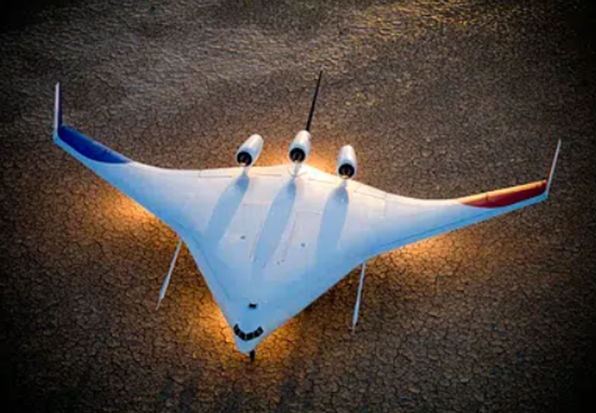
Boeing’s X-48B test vehicle claims up to 30% lower fuel burn than today’s standard commercial aircraft. Airbus is pursuing similar innovations with its MAVERIC prototype under Europe’s Clean Sky initiative. Meanwhile, the U.S. Air Force is exploring BWB designs for future tankers and transport aircraft, signaling broad civilian and defense interest in this next-generation aerodynamic revolution.
Boeing X-48B
Despite its promise, BWB aircraft face significant challenges. Its unconventional shape complicates cabin pressurization, window placement, and passenger boarding or evacuation procedures. Certification will require new safety standards and rigorous testing, as existing regulations assume tube-and-wing designs. Structurally, the BWB demands advanced composite manufacturing and careful load management. Airport compatibility also poses issues as its wide span may strain gate access, taxiways, and ground handling systems. Overcoming these technical, regulatory, and operational hurdles will be crucial before the BWB can transition from experimental concept to commercial reality.
The first commercial or military variants could enter service by the 2030s or 2040s, reshaping both narrow and wide body aircraft markets. BWB designs promise dramatic efficiency gains that could disrupt traditional airframe categories, while hybrid configurations may serve as transitional steps between current tube-and-wing layouts and fully integrated wings. This evolution could redefine the economics and environmental footprint of future air travel.